
The Three Pillars of Digital Resilience Support
Reading: Three Pillars of Digital Resilience Support
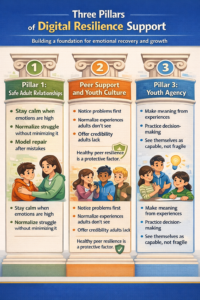
Digital resilience does not develop in isolation. It grows through a network of relationships, experiences, and opportunities that help children recover from stress and remain engaged with the world. Three key pillars support this process.
Pillar 1: Safe Adult Relationships
Children need adults who provide emotional stability, especially when situations feel overwhelming. Safe adult relationships are defined less by having the “right answers” and more by how adults respond in moments of stress.
Supportive adults:
- Stay calm when emotions are high, helping regulate rather than escalate reactions
- Normalize struggle without minimizing it, acknowledging difficulty without dismissing it
- Model repair after mistakes, showing that missteps can be addressed and resolved
These behaviours teach children that challenges are manageable and that support remains available even when things go wrong.
Pillar 2: Peer Support and Youth Culture
Peers play a powerful role in resilience. Children and adolescents often turn to peers first, especially in digital spaces where adult presence may be limited.
Peers can:
- Notice problems before adults do
- Normalize experiences that adults may not see or fully understand
- Offer credibility and understanding that adults sometimes lack
When peer culture supports empathy, repair, and reflection, it becomes a strong protective factor. Encouraging healthy peer connections helps children feel less alone and more capable of navigating challenges.
Pillar 3: Youth Agency
Resilience strengthens when children are active participants in their own recovery and decision-making. Agency does not mean independence without support; it means having opportunities to think, choose, and learn.
Agency grows when children:
- Make meaning from their experiences rather than being defined by them
- Practice decision-making in low-risk situations
- See themselves as capable and developing, not fragile or easily broken
Together, these three pillars create a balanced foundation for digital resilience—one that supports children emotionally, socially, and cognitively as they navigate complex digital environments.
Reflection
- Which pillar is strongest for my child right now?
- Which needs intentional strengthening?